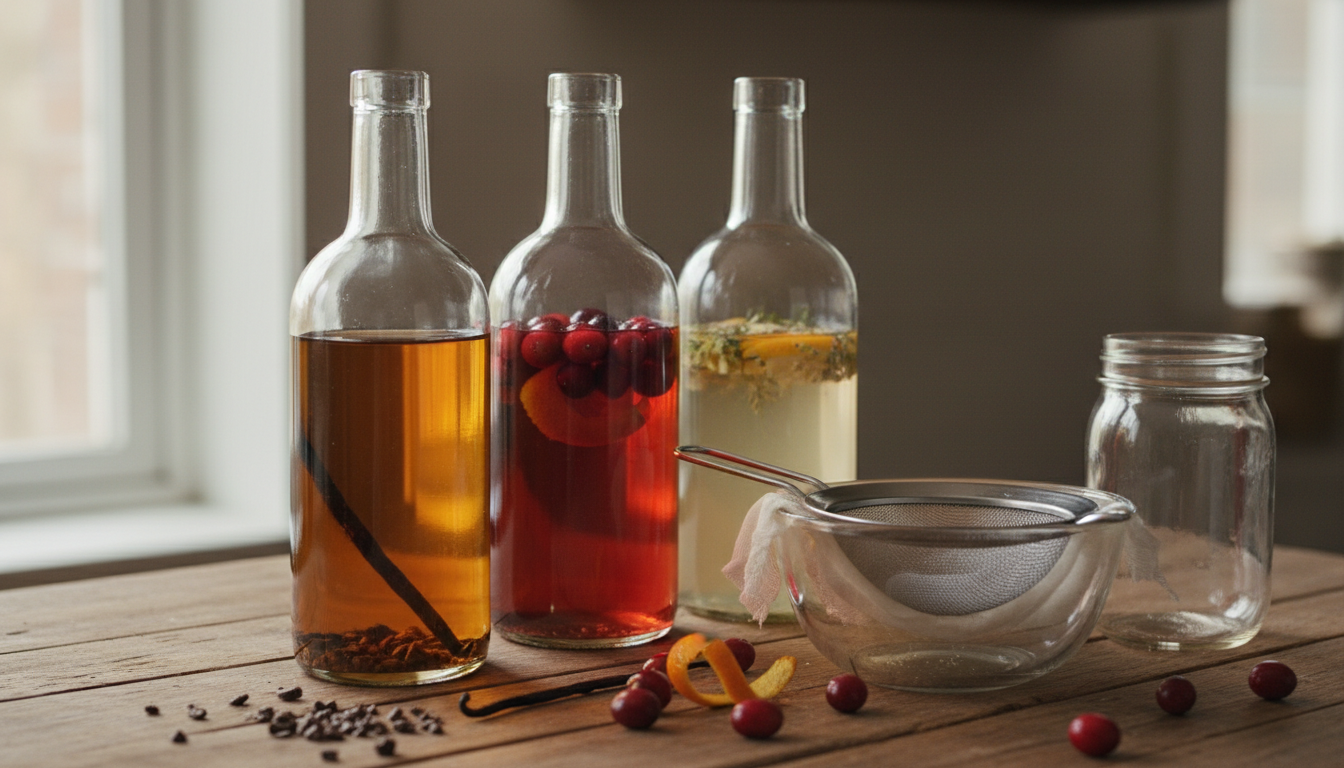
Strained and bottled, a homemade infusion made with full-strength vodka, rum, bourbon, gin or tequila keeps its best flavor for up to about a year in a cool, dark cupboard. Add sugar syrup and you have a liqueur, which is best within six months to a year once opened. Add cream and it lives in the fridge and is finished within two months. The one habit that shortens every one of those numbers is leaving the fruit, peel or spice in the jar after the steep is done.
Our recipe pages tell you how long to steep. They don’t tell you how long the bottle keeps once it’s strained, and that is the question people ask the week after they make a batch. This guide fills that gap, by type, with a link to where every number comes from.
The short answer, by type
| What you made | Examples on Build the Bottle | Where to keep it | Best within |
|---|---|---|---|
| Straight infusion, solids strained out, no sugar | Pear and Cranberry Infused Vodka, Chocolate Infused Bourbon without the syrup | Cool, dark, dry cupboard | Up to about a year (Nigella, for spice infusions) |
| Sweetened liqueur | Cranberry Infused Rum, Chocolate Infused Bourbon with the syrup | Cupboard; fridge once opened if you won’t finish it in six months | About 6 months to 1 year after opening (Tasting Table) |
| Fruit liqueur | Pear Liqueur | Fridge if it won’t go quickly | About 6 months (Tasting Table) |
| Citrus “cello” | Citrus zest and juice steeped in vodka or Everclear | Freezer | Up to 1 year (The Alcohol Professor) |
| Wine-based infusion | Cinnamon Infused Vermouth | Fridge from the day you open it | Much shorter than spirits (Tasting Table) |
| Cream or dairy liqueur | Homemade Irish cream style | Fridge, always, in a sterilized sealed container | Up to 2 months, sometimes only a few weeks (The Daily Meal) |
Why one site says 7 days and another says a year
Search this question and you get answers that can’t all describe the same bottle. One bartending school’s guide says infused vodka “lasts 7 days but can last a little longer in the fridge.” Nigella Lawson’s team says spice-infused spirits “will last for up to a year.” The same bartending school notes that plain vodka, once opened, can last over 10 years.
Neither answer tells you what’s in the bottle, and that is the whole question. Three things decide it.
- Alcohol. Alcohol kills most bacteria, so higher-proof spirits resist spoilage better after opening, as Tasting Table explains.
- Sugar. Sugar gives microorganisms something to feed on. The more syrup you add, the sooner the bottle changes, which is why liqueurs turn before straight infusions do.
- What’s still in it. Fruit, peel and dairy are the parts that break down. Strain the solids out and you are left with flavored spirit. Leave them in and the flavor keeps moving.
A bottle of vodka with a lemon still floating in it on the counter and a strained, filtered bottle of lemon vodka in a dark cupboard are two different drinks with two different shelf lives. Most of the confusion online comes from treating them as one.
Strain it out, then the clock starts
The infusions on our site end the same way: strain through moistened cheesecloth, wring it gently, then strain again through a coffee filter. Our Cranberry Infused Rum steeps two weeks in a cool, dark place with a shake every day or two. Pear and Cranberry Infused Vodka needs at least three weeks away from sunlight, with the fruit kept fully under the vodka. Chocolate Infused Bourbon steeps three weeks with cocoa nibs and a split vanilla bean, then rests 15 days in a dark place and gets filtered again before it is bottled.
Steeping longer does not buy you shelf life. One contributor to The Alcohol Professor left a pear and vanilla infusion in a cabinet for eight months and reports it was not good. Nigella’s team warns that an infusion can become very strong if it is left too long. Taste as you go, strain when it tastes right, and count the shelf life from the day you strain, not the day you started.
Then write that date down. The Alcohol Professor’s advice is to label each batch with the ingredients, the ratio of flavoring to spirit and the steeping time. Add the strain date and you will never stare at an old bottle wondering how old it is.
Storage checklist
- Strain twice: moistened cheesecloth first, then a coffee filter.
- Bottle into a sterilized bottle with a tight seal. Nigella’s team says the same for spice infusions, and The Daily Meal says it for cream.
- Keep it cool, dark and dry, and out of direct sunlight.
- Label it: what’s in it, the ratio, the steep time and the date you strained it.
- Opened a sweet liqueur you won’t finish within six months? Move it to the fridge.
- Anything with cream or dairy goes in the fridge from day one.
- Vermouth and other wine-based infusions go in the fridge as soon as they’re opened.
- Citrus cellos go in the freezer.
Liqueurs and cream: the short-lived ones
Once you stir in syrup, you have a liqueur. Tasting Table puts most liqueurs at about six months to a year after opening when stored properly, and says liqueurs with fruit or cream should be drunk within about six months or refrigerated. Wine-based drinks like vermouth spoil much faster than spirits and belong in the fridge right after opening, which is worth knowing before you make our Cinnamon Infused Vermouth.
Dairy is its own category. Homemade Irish cream keeps in the fridge for up to two months, according to The Daily Meal, and some recipes last only a few weeks to a month. Even store-bought cream liqueurs break the usual rule that a sealed bottle lasts indefinitely: Tasting Table notes that Baileys lasts about two years from its bottling date, unopened. A homemade bottle has no factory seal at all, so treat it as open from the day you make it.
Limoncello and the other citrus cellos are happiest cold. The Alcohol Professor’s recipe steeps zest for four weeks, rests sealed at room temperature for 7 days, then goes in the freezer, where it keeps for up to a year.
How to tell a bottle has turned
A dull bottle and a bad bottle are different problems. A year-old infusion that tastes flatter than it did in month two is past its best. A bottle that has spoiled shows it. Before you pour, Nigella’s team says to check for sediment, cloudiness, mould, off smells or flavours, or a thick, oily or slimy texture, and to throw the bottle out if you find any of them. For cream liqueurs, The Daily Meal adds: if the aroma has changed or the texture looks wrong, discard it, and only taste a tiny sip from a spoon if it looks and smells fine.
Giving bottles this season
An infusion is a personal gift because you made it. If you would rather hand over something that looks like it came off a distillery line, with a label that carries your name, we bottle it for you.
On our Order Your Own Custom Bottle page you pick vodka, bourbon or whiskey, gin, rum or your own recipe, choose 80, 90 or 100 proof, and can start from any recipe on this site. Then you design the label: the name, a second line such as “Batch No. 1,” a short message, the lettering and the colors. It all goes into one clear 750 ml wine bottle with straight sides and a flat panel. The type of spirit, alcohol content, 750 ML, bottler and government warning are required by federal law, so the designer locks them in place and stops wording or colors that aren’t allowed.
Standard spirits are priced right on the page. Your own recipe gets a personal quote. Every bottle is filled at Terebelo Distillery, and nothing is bottled until the distillery approves the label. Alcohol is sold and delivered only where the law allows, to adults 21 and over.
Build the Bottle is one of a family of companies. You can see the rest, from the distillery to our compliance games, on Our Companies.
Make a batch, then make it a bottle
Pick an infusion from our Recipes, strain it on time, and label it with the date. When you want a bottle worth giving, design your custom bottle now. The price for standard spirits shows up as you build it, and nothing is charged on the page.